



Part of this trip is about getting back into motorcycling. Part involves seeing West Coast Friends. And part is a busman’s holiday: I’m attending the Medieval Association of the Pacific (MAP) annual conference at Pepperdine University, and then heading up to the Coursera Future of Higher Education Summit.
This morning I drove down to Manhattan Beach to have breakfast with the organizer and host of the MAP conference, Prof. Jennifer Smith. Jennifer invited me to breakfast at The Kettle just before the conference begins, and I jumped at the chance.
I don’t know how you made time , Jennifer. Thank you.

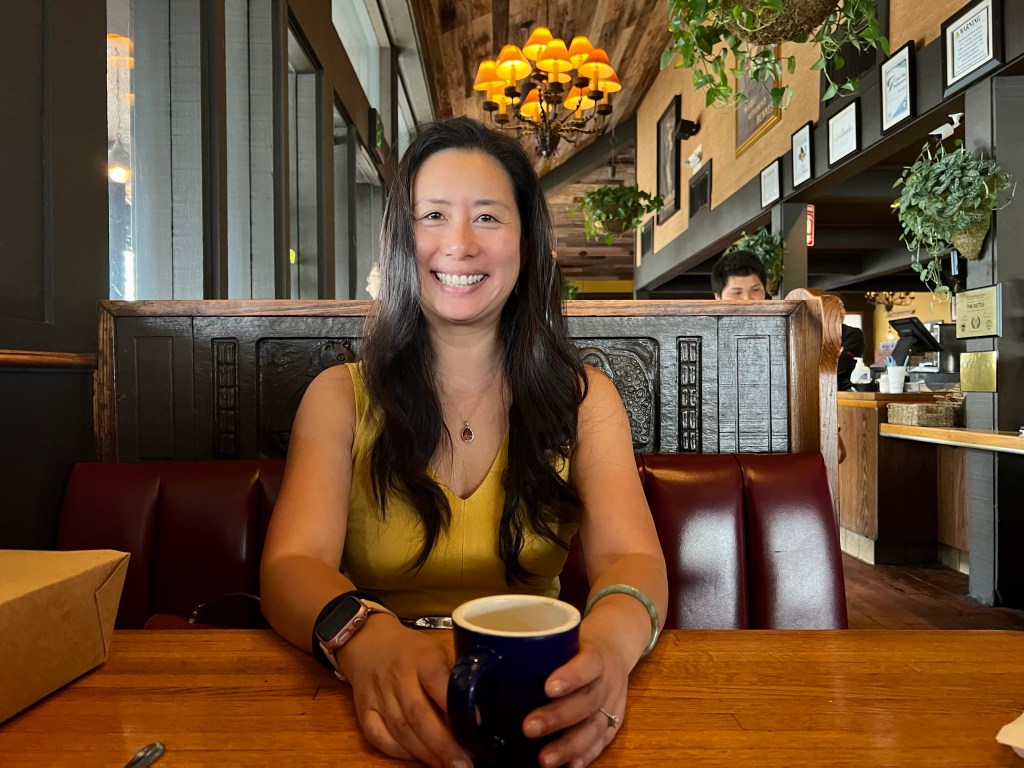
Jennifer and I both write on fifteenth-century English literature and are both have been drawn into academic administration. Jennifer has just stepped up to a position as Associate Provost at Pepperdine. And so she invited me not only to breakfast but to participate on a round table discussion about scholars of the Middle Ages who serve as administrators.
Academic administration needs great people like Jennifer involved in it right now. Higher education faces a number of tensions: public funds have been sucked out of public universities driving tuition costs ever upwards, and demographic and enrollment patterns are shifting radically, as are the expectations for a college degree. Most recently, higher education is under intense political pressure, from outside and from within.
Part of my mind is churning away on the relationship between teaching, higher administration, and scholarship. I’ve been thinking, too, about yesterday’s museum visits—about the artifacts arrayed at the Japanese American National Museum, and about abstract expressionism in the fifties, sixties, and seventies.
My mother painted all through the college in the 1950s and well into the 1970s. Her style became more surreal in the seventies, but the heart of her work, as I know it, was abstract expressionist.
None of her work is titled. Two matching pieces, white and gray, are probably my favorites.
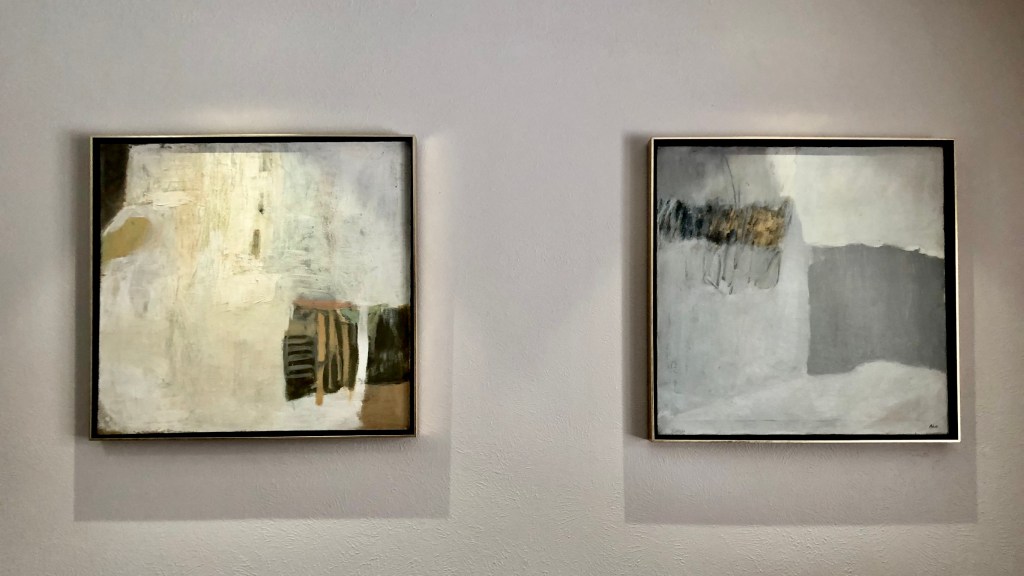
Each of these two paintings has a dominant color scheme that establishes its field: the white one and the gray one. For the most part these fields are coherent—the gray one has sections of different shading, the white one has sections of texture created by the brushwork. The fields are intruded into—made momentarily incoherent—by chaotic black and gold sections (black and gold and green in the case of the white painting).
I think of these intruding sections as storm clouds of complexity in the otherwise coherent fields of thought. Yet the storm clouds also connect the two paintings, suggesting that when you step back from either painting, you can see that even chaotic intrusion operates according to a larger patterning.
A second favorite of mine is of concentric squares painted in a stippled fashion.

This was, if memory serves me, part of a series of paintings in different color schemes, each featuring short hard brush strokes that made the paint literally stand off the canvas. These strokes gives the painting a dimensional quality that, in its way, complements the overall design: as the squares enclose one another to move inward, away from the viewer, the ridges of paint reach outwards, leaping off the canvas toward the viewer.
While the design itself thus implies symmetry, the painting itself is misaligned: there is a singular asymmetrical line in blue on the right, and the canvas itself is far from square. As a result, the whole painting appears to symmetrical but is twisting and turning in tension, moving inward and outward, a helter-skelter square.
This is much the way I perceive the world—symmetrical at first, but upon inspection, not at all, instead a series of tensions pushing and pulling against one another.
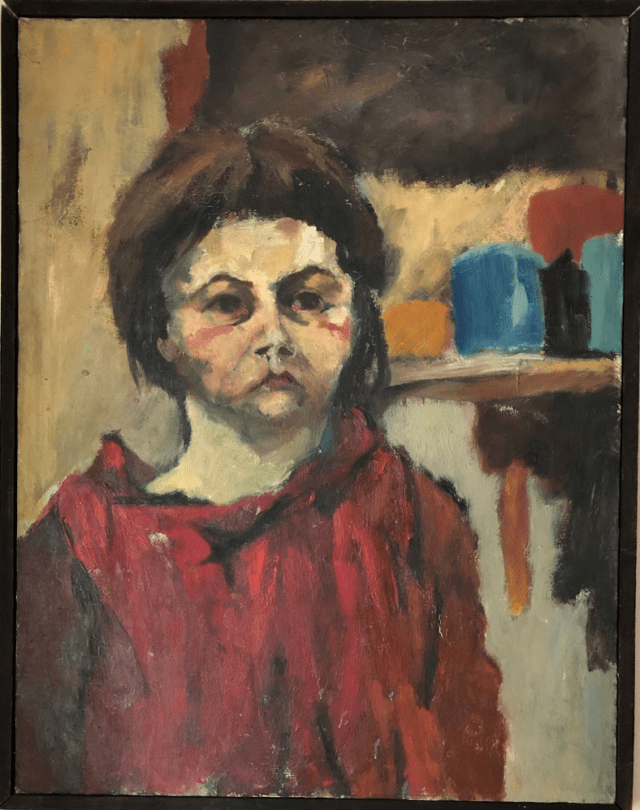
A final favorite is my mother’s self portrait from 1957, when she was at Bard College. Somewhere along the line I found a picture of her in her dorm room from the same period. They both capture something of who she was as a person.

The painting perhaps emphasizes her stubbornness, intensity, and anger to a greater effect, but those qualities are in the photograph as well. Both have an intentional muddiness, too. The painting is executed as if she didn’t fully clean her brushes, and that murkiness is in the photo in the wall behind her and the table next to her.
I’m yoking together too many things here—abstract representation, the tensions facing academic administration, and the trauma of police action: forced incarceration and police squads on campus.
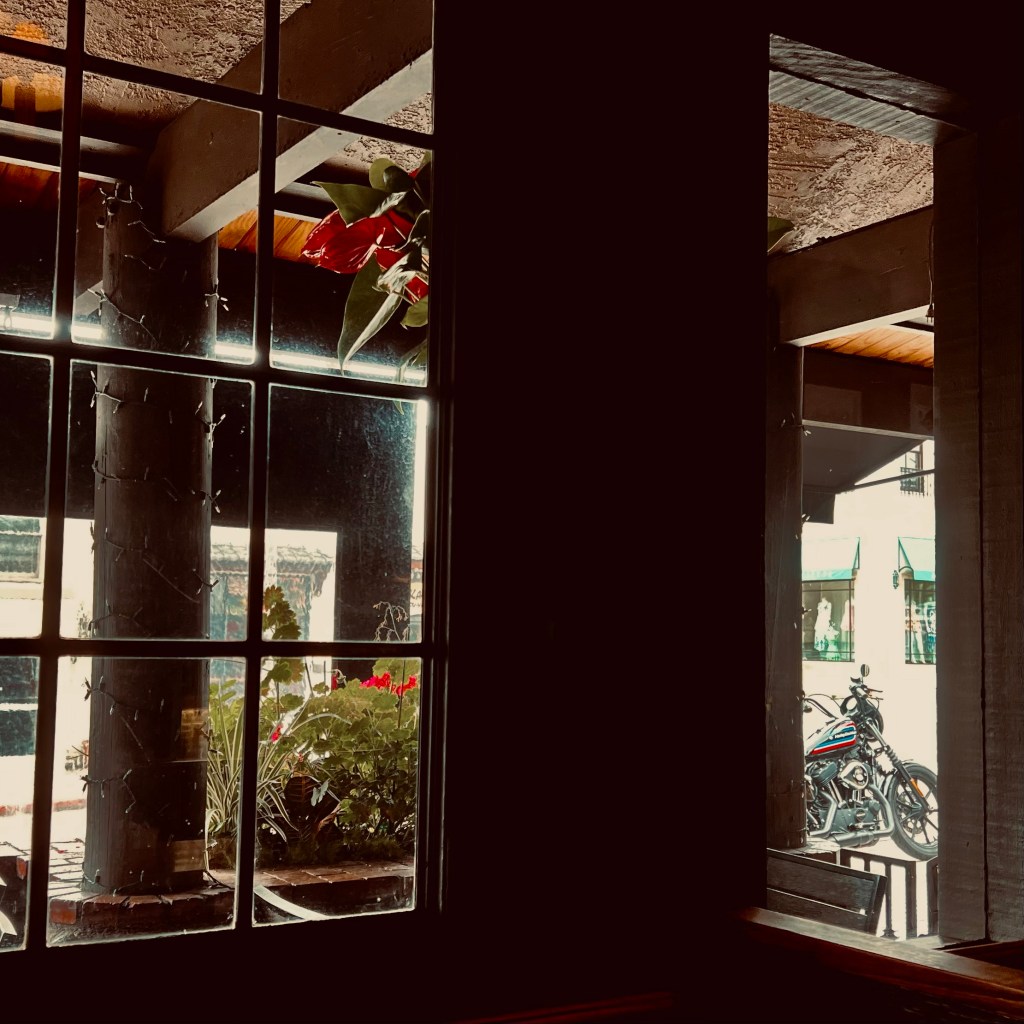
The thread I am trying to pull on is the relationship between articulation and the truth that lies in the representational space of abstraction. Can a specific feeling of horror or unease or chaos be fully articulated, or is it as in J.T. Sato’s image, truly just a darkness at the edge of the frame. And if it is a darkness, a chaotic intrusion, how do you navigate it?
Perhaps some complexities cannot but fully discerned, but appear only as storm clouds—peppering hail—that we must ride out.
 Onwards!
Wow, brilliant post with so much to take in!
Manhattan Beach is one of my favorite places in LA area – hope you enjoyed it.
Viktoriya O.
LikeLiked by 1 person
Thank you so much. I was worried that one was too pretentious and not finished enough. Wonderful to see your name, VO!
LikeLike
My heart is with so many of you serving in leadership roles during these increasingly turbulent and challenging times in higher education. Thank you for serving again and again and again in critical leadership roles, William. You are GREAT at what you do. I hope you know that. Also, loved reading about and seeing examples of your Mother’s art journey. I have just begun painting a few months ago and find myself lost in enjoyment of creativity and color. And, stippling is becoming one of my favorite approaches. Trying much to hard to make things look just right – haha! Enjoying your blog very much. Thank you for making time to share your journey with us. Enjoy! deb
LikeLiked by 1 person
So glad you’re painting, Deb. That’s wonderful. Don’t try to hard to make things look right! I did some drawing classes during COVID and it was fantastic. Thanks for reading!
LikeLike
Further to “demographic and enrollment patterns are shifting radically,” see the Wall Street Journal story today, “Gen Z Plumbers and Construction Workers Are Making #BlueCollar Cool” (link)
Hopefully our obsession with college as the path for everyone is fading; but that’s not good new for people who’s job depend on teaching college kids.
Excerpts, in case the article ends up paywalled:
‘The number of students enrolled in vocational-focused community colleges rose 16% last year to its highest level since the National Student Clearinghouse began tracking such data in 2018.’
‘On TikTok, the hashtag #bluecollar drew 500k posts in the first four months of this year, up 64% over the same period in 2023. Posts hashtagged #electrician increased 77% over the same time, with #constructionworker and #mechanic posting similar jumps, TikTok says. ‘
‘Pfister Faucets spent $2 million to produce a YouTube documentary series, now in its fifth season, highlighting the lives of plumbers around the country. . . . The shows, aimed at getting people interested in plumbing as a career, have racked up 13 million views, with half coming from people ages 34 and younger. ‘
LikeLiked by 1 person