


I like time-tested design.
Time-tested design resists obsolescence. Many time-tested things survive in the marketplace by heading upmarket. Rolex Watches and Mont Blanc pens are good examples of this phenomena. But time-tested design isn’t necessarily luxurious by definition. It’s functionality isn’t necessarily quantifiable either: the Colt 1911 pistol, named for the year it was designed, has certainly been superseded in terms of quantifiable metrics by no end of plastic handguns, but a lot of people still prefer the older gun so much that they stake their lives on it.
I’m sure you have a few of these things in your life. They needn’t be machines. The value of time-tested design inheres in all kinds of things, from musical instruments, to tools, to furniture—you name it.
What I’m taking about is different from sentimental value, too, which accrues because of our experiential relationship with a particular thing. We might have a car that is really quite awful, but because of trips we’ve taken in it and the people who have ridden in it with us, we just can’t part with it. Those things have character, too. I am referring to something different than the sentimental worth of a particular object.
By time-tested design, I mean a design that augments quantifiable functionality in such a way as to make the thing better to work with than a replacement that, in fact, might function better quantitatively. Because of that quality—it’s often called “character”— the thing either stays in production regardless of technological improvements to the genre overall, or is sought after, not as an investment, but for real-world use long after it’s production run ends.
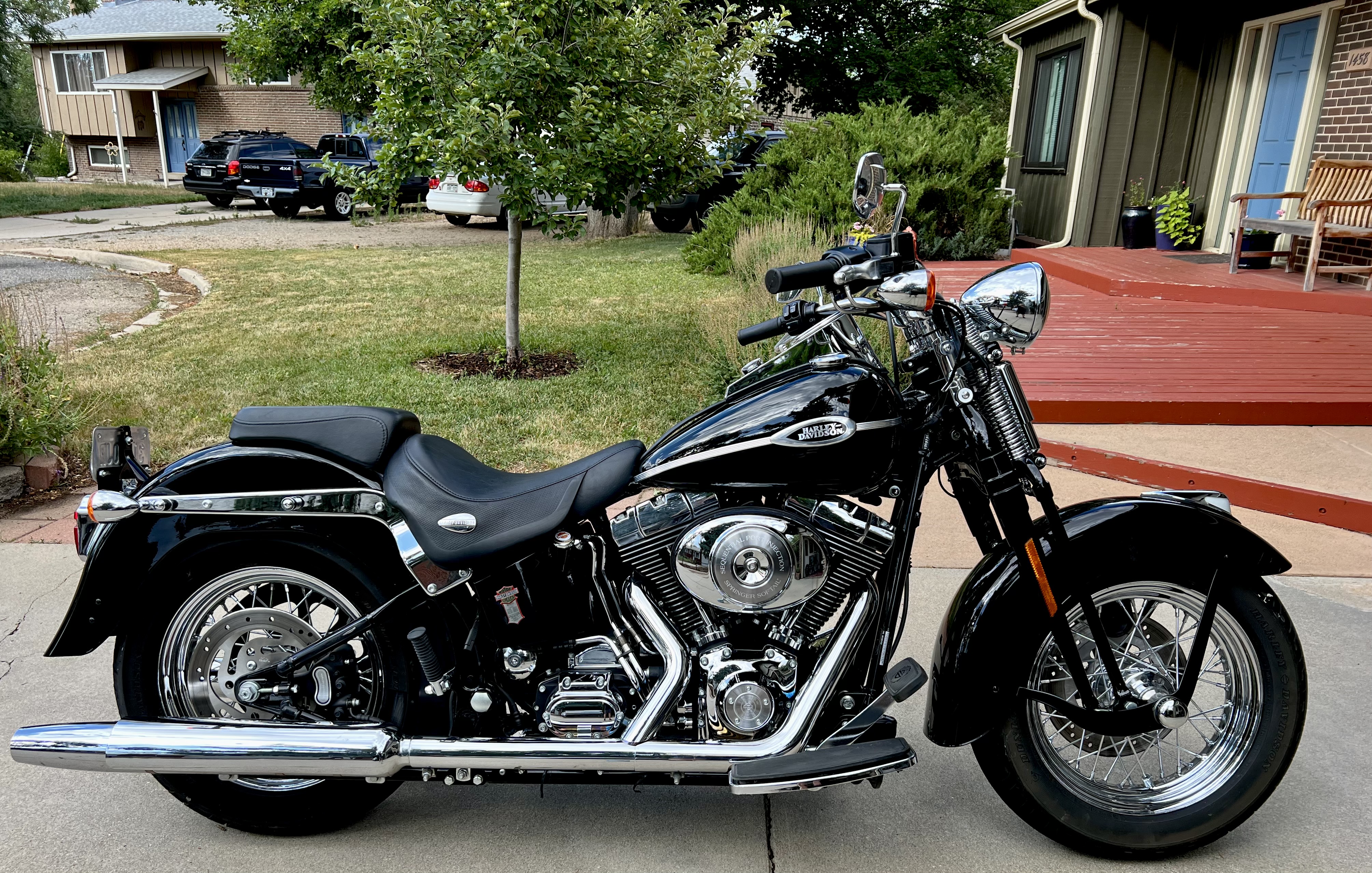
The Harley-Davidson Springer Softail Classic is just such a thing.
I had been looking for a Springer half-heartedly for about a year. They’re around, but their owners usually price them pretty high. Since Harley stopped making them in 2007, a lot of those pricey bikes have a fair amount of miles on them. Plenty of them are tailored to their owners’ particular tastes. There’s no accounting for taste, is there?
Yesterday I bought one from Coy. I saw Coy’s ad on Craigslist a week ago and wrote him what can only be described as “an extremely low ball offer.” Coy politely told me that the bike was already sold. I cursed my luck because Coy’s Springer had only 2,200 miles on it and was bone stock. I deserved what I got. I had, after all, made an extremely low ball offer.
A few days later Coy wrote me back and graciously accepted. No bargaining. The earlier buyer had offered a series of excuses instead of money and, apparently, Coy wanted the bike gone.
Helen drove me up to Buena Vista, CO this morning. We passed through Leadville, which was cute as a button.




Coy was a true gentleman.
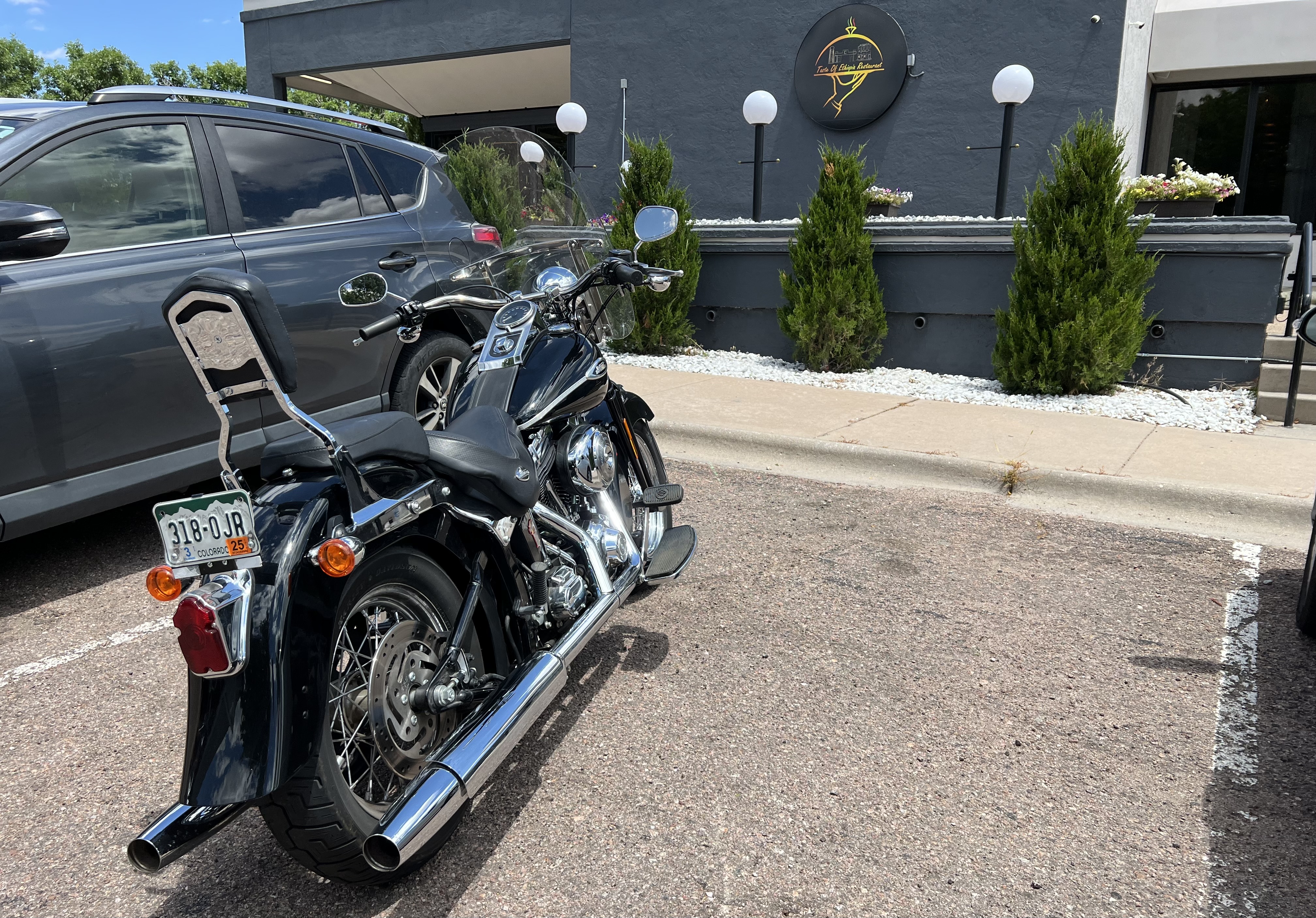
The purchase took about fifteen minutes, and Helen and I drove in tandem down to Colorado Springs where she had found an Ethiopian restaurant, A Taste of Ethiopia, which was great.
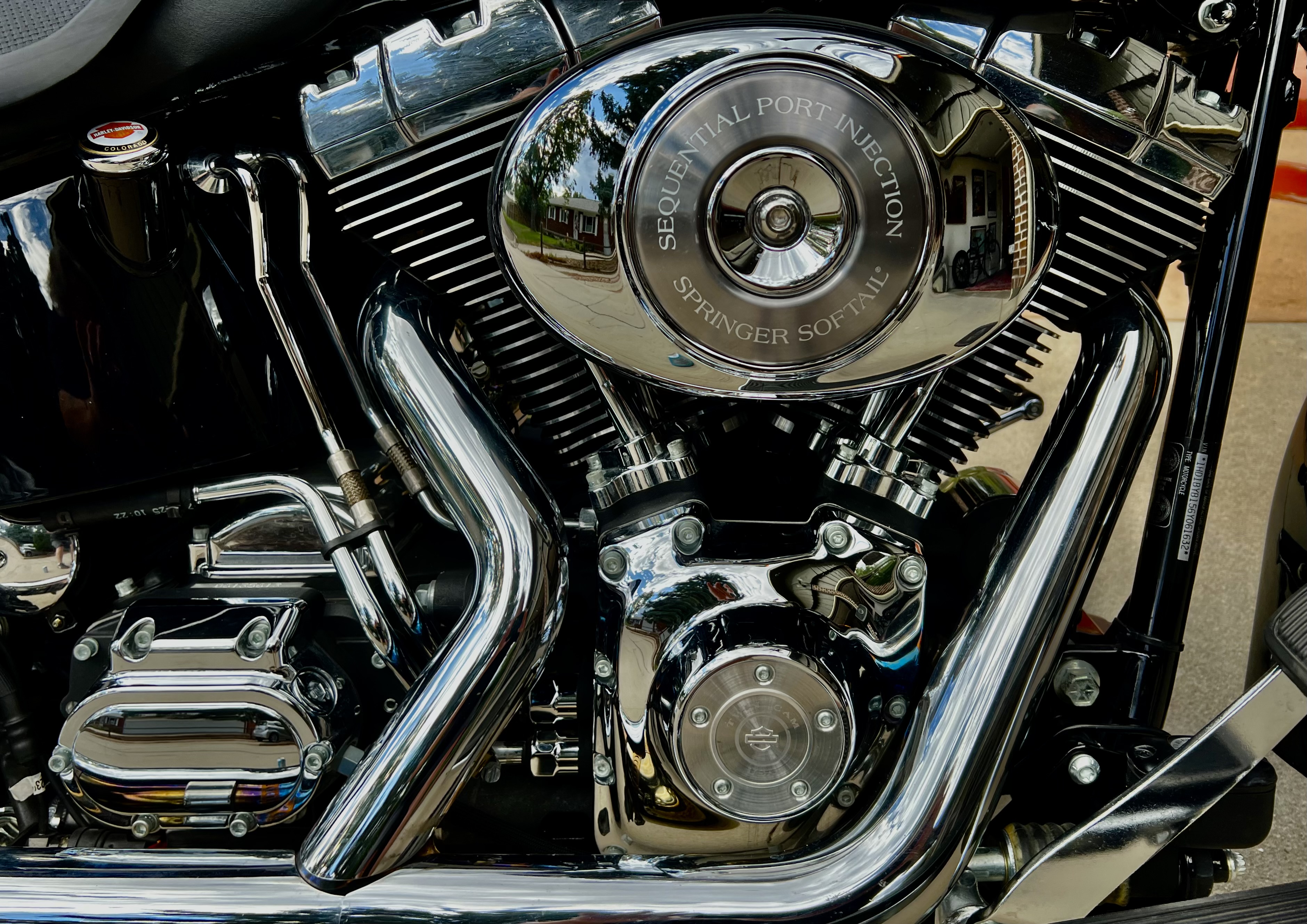
The bike performed flawlessly, and I shined it up for the remainder of the afternoon. It’s not perfect—it’s eighteen years old for goodness sake—but it is fine. Very fine.
“What is a Harley Davidson Springer Softail Classic?,” you might ask. You might not ask, too, but if you keep reading you are going to find out.
Harley-Davidson made the “Softail” from 1984 to 2018. The model tied in to Harley’s relaunch in 1981, a time the Motor Company was gathering together its history as an important part of its brand identity.
The Softail was designed by a Harley engineer named Bill Davis in the 1970s.

The idea was to mimic the look of the “rigid” frame motorcycle of the past. To the left you can see Peter Fonda’s Wyatt riding the Captain America bike, which has no shock absorbers. It’s a rigid ride and it looks it. Bad for the back and worse for the kidneys. Still, the rigid frame has a beautifully clean line from the steering stem (where to front fork meets the frame) all the way down to the rear wheel.
That clean line reduces the bike to very simple shapes—circles and triangles, really—creating it as spare and powerful.
Timeless.
Bill Davis’ idea was to hide two shock absorbers under the bike. Called the “sub shocks,” these actually work opposite to normal shocks, expanding with bumps rather than compressing. The whole thing may seem like a nonsense styling exercise, but in fact the Softail design works beautifully because it allows for an exceptionally low center of gravity. You sit in the bike, rather than on it, and the feeling is embracing and thus reassuring. That accounts for the run of thirty four years in production.
The Springer takes the Softail concept a step further by adding a retro front fork from the thirties. Rather than the fork using hydraulics, the Springer just has two big springs that absorb the bumps (it does have a little shock absorber too).

The result is a bike styled after, and in part engineered according to, the Harley Davidson “Knucklehead,” a legendary bike Harley produced from 1939-1947. I will spare you, dear reader, the history lesson on why the “Knucklehead” is so special, but the new bike is a tribute to the old bike that actually makes do with the old-fashioned fork.


What is so wonderful about the Springer Softail is that it works, and it works well.
The Softail frame provides a low, agile, easy-going ride, and the Springer fork, rather than being an antiquated mess, is confidence inspiring. It’s a tribute that is also a legitimate thing in it’s own right, an analogue recreation of the past for a digital world.
For me, the Springer is a refreshing change from the Rocket. My touring bike isn’t called the “Rocket” by Harley, but that’s what I call it, and that’s what it is. Harley calls the Rocket a “Softail,” but it’s a different beast entirely from Bill Davis’ idea, one engineered more like a sportbike with a sophisticated monoshock and an extremely modern front fork.


The Rocket is built for speed. Its seating position leans you into the oncoming road, fists forward like Iron Man blasting into the future. The Springer sits you upright, like at dinner, wrists a little angled and low, by your rib cage. The position is agricultural, like driving an old tractor with a steering wheel that’s angled near flat.
As a result, the Springer is happier going the speed limit or even a bit slower. It absorbs the bumps and it can lean over, but the feeling isn’t about aggression so much as competence.
I had hoped that the Springer would prove itself a time-tested design. It is neither a collector’s item—they made too many of them for a version at the end of the model run to have collector’s value—nor a technological wonder. It is a motorcycle that can function at current highway speeds yet is not feel defined by our age’s trends.
Harley doesn’t built the Springer any more because that front fork is just to expensive to make.
In that, the Springer feels somewhat anti-progressive and anti-obselesence.
Literature and fine art are that way, too. They work, not according to bare metrics of functionality but according to how they exceed the functions of telling a story or decorating a room or representing a person to communicate across time.
Come to think of it, I feel like I just bought a piece of industrial art.


I’ve never cared much for looking at, riding or caring about motorcycles……not my jam, so they say. But your writing draws me into learning about them and appreciating the nuances. Thanks for your continued Onwards adventures….so fun to read.
LikeLike
Thanks for this comment. It means a lot to me.
LikeLike
Gonna need a bigger garage Wm
… and a lift😆
LikeLiked by 1 person
Too true. I would like a lift.
LikeLike